

Gen Z: tomorrow's consumers
Within a few years, Gen Z will be the main consumer force in many African markets. Yet many marketing strategies still treat it as a secondary audience.
Gen Z was born between the late 1990s and the early 2010s. Many of them are now young adults. Most 18 to 24-year-olds are still studying or starting their first jobs, so they spend little today. But as they enter the job market and their incomes rise, they are set to become one of the most important consumer groups on the continent.
For brands, this makes them a valuable long-term audience. They are not always ready to make major purchases today, but they are already discovering new brands, forming preferences and influencing the purchasing decisions of their families and friends. Building a relationship with them now can create loyalty that lasts for years.
Today, the best way to reach them is digital advertising, as long as it is planned for their reality.
Gen Z's online reality
Gen Z is the most connected generation, globally and in Africa. 15 to 24-year-olds are almost twice as likely to beonline as the rest of the population (ITU, 2025).
Africa's digital landscape is evolving, but millions of people are already online. At the end of 2025, there were 34.7 million internet users in the DRC, 13.4 million in Côte d'Ivoire and 11.5 million in Senegal. Internet access among 18-24 year-olds varies from country to country, but a large and growing share of this generation is already online. For brands, this means digital advertising provides access to millions of young consumers, and as internet penetration continues to rise across Africa, this opportunitywill only grow.
What stops many people from going online, or from using the internet more, is not the network but the price of data and phones: in Sub-Saharan Africa, 20 GB of mobile data costs on average 14% of monthly income (GSMA, 2026). Young people adapt and stay connected anyway, constantly juggling public wifi, limited data bundles and intermittent 3G/4G connections.
Africa is a mobile-first continent, and for Gen Z the smartphone is the screen for everything. In Côte d'Ivoire, mobile accounts for around 98% of all internet subscriptions (ARTCI, 2025).
Mobile money is widespread, but it is still used mainly to send and store money, not to pay for purchases. Many online orders are paid in cash on delivery, often after placing their order via social-selling on whatsapp or other platforms.
Speakingto Gen Z means speaking its language
One of the most common mistakes in campaigns is to treat French-speaking Africa as a homogeneous market.
While French remains a central language of communication, young consumers navigate rich and diverse cultural environments every day. On social media, video platforms and messaging apps, local languages play an important role. For example, a 2025 study of Senegalese social media comments found more comments in Wolof than in French, and many people mixed the two in the same message (Springer, 2025).
Cultural references, humour, visual codes and linguistic expressions vary greatly from one country to another, and even from one region to another.
The brands that succeed are those that go beyond simply translating their campaigns to develop truly contextualised communication. The goal is not only to be understood, but to be seen as relevant and authentic.
Beyond social media: expanding your reach
Social media remains essential, but on its own it cannot deliver the full potential reach.
To reach Gen Z, social media naturally remains a pillar of digital strategies, and advertising opportunities vary considerably by platform and country. Meta remains the most widely available paid social platform in French-speaking African markets. Other platforms have more limitations. For example, YouTube advertising is currently only available in Senegal among French-speaking African markets. TikTok also presents challenges, with ad availability that varies by market and restrictions that can complicate multi-country campaign management.
However, limiting a media strategy to a few social platforms means ignoring a large part of real digital usage. Young internet users visit news sites every day, watch video content, stream music, play mobile games, follow sports results and use entertainment apps. Their digital journey is fragmented and takes place across a multitude of environments.
It is therefore essential for brands to diversify their advertising channels.
Why programmatic advertising matters
Programmatic advertising, which places ads across thousands of websites and apps at once, can reach 65,7% of GenZ in Côte d'Ivoire, 68.9% in Senegal and 29.2% in the DRC. In all three markets, its reach exceeds that of any single social network.
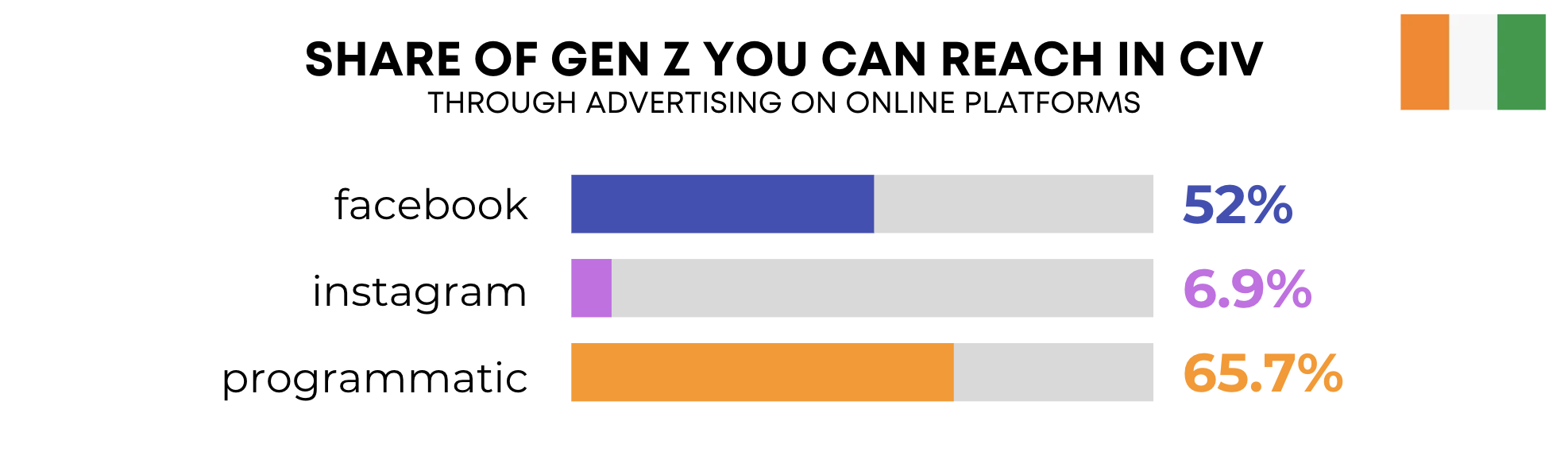
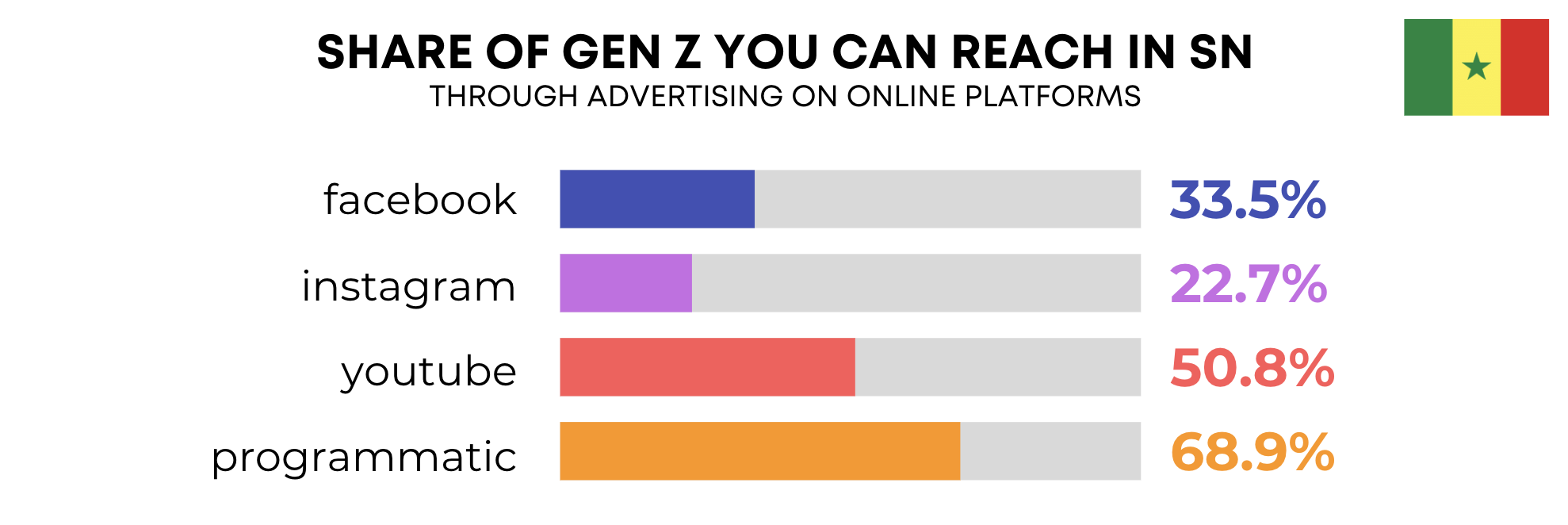
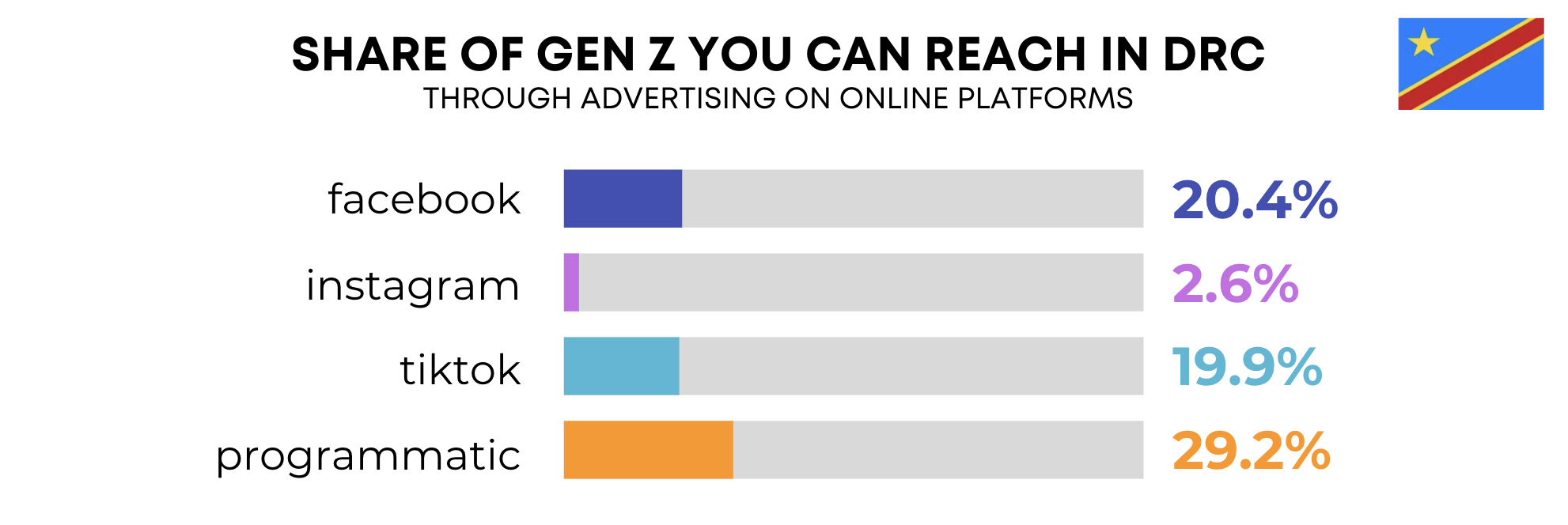
These figures do not make programmatic THE answer, but they show that it deserves a real place in the mix, alongside social platforms. It makes possible to reach young people where they spend time outside social media, and to reduce dependence on one or two platforms whose ad availability varies from market to market.
Rather than manually buying ad space site by site or app by app, programmatic advertising uses automated systems to deliver ads across a vast network of digital platforms. This includes news sites, entertainment platforms, sports content, music streaming services, mobile game sand many other apps and sites where young people spend their time.
This approach allows brands to reach their audiences across their entire online behaviour, not only when they are using social media. Advertisers can define who they want to reach using criteria such as age, interests, location, device type or online behaviour. The system then delivers ads at scale to these audiences while continuously optimising performance in real time.
Programmatic advertising is already used by many brands in African digital markets. However, its full potential has yet to be exploited.
Planning a campaign that works
To reachGen Z in Africa, the brands that succeed will do six things:
1. Adapt the mix to each market. Platform availability and reach differ from one country to another, so a plan that works in Senegal will not necessarily work in the DRC. Combine social media with programmatic to reach Gen Z beyond social networks.
2. Speak their language. Adapt messages to local cultures and languages rather than simply translating them.
3. Design for mobile first. Build every creative for the phone screen: vertical or square formats, visuals that stay clear on a small screen, and a message that is understood in the first seconds.
4. Keep ads light: your audience is cautious about its data usage, so you should be too. Use lightweight ads and short videos, and wifi targeting for heavier ads.
5. Make the next step easy: lead customers along the journey they are used to, and give them a simple way to act, such as a click-to-USSD, click-to-chat or call button, a clear delivery offer, or the nearest store.
6. Measure the real impact. A campaign's real impact is not only about direct sales. Track attention and engagement with the ad, conversations started on your chat, or by phone, offline results such as promo codes, and brand growth over time.
Building tomorrow's preference today
The brands that win tomorrow will not alwaysbe those that spend the most, but those that understand first how this generation gets informed, interacts, buys and chooses.
The question is no longer whether to invest in Gen Z, but how to build, starting today, a digital strategy that earns their trust, attention and preference for years to come.
Sources
ITU, Factsand Figures 2025: Youth Internet use.
GSMA, Stateof Mobile Internet Connectivity 2026.
ARTCI,telecommunications market statistics, Q4 2025 and Q1 2026.
BCEAO, 2025 financial statements.
DataReportal, Digital 2026: Côte d'Ivoire, Senegal and Democratic Republic of the Congo.
GenZ reach by platform and programmatic reach: analysis basedon Meta, TikTok, Google and Adform advertising tools, September 2026.
FAQ
Who is Gen Z in Africa?
Gen Z refers to people born between the late 1990s and the early 2010s. In Africa, many are now young adults who are studying or starting their first jobs. As their incomes rise, they are set to become one of the most important consumer groups on the continent.
How does Gen Z in Africa use the internet?
Gen Z is the most connected generation in Africa. Most go online through smartphones, often juggling public wifi, limited data bundles and intermittent 3G/4G connections. Beyond social media, they read news sites, watch videos, stream music, play mobile games and follow sports.
Why is Gen Z in Africa important for brands?
Gen Z is already discovering brands, forming preferences and influencing the purchasing decisions of family and friends. Brands that build relationships with them now can create loyalty that lasts for years as their spending power grows.
What is the best way to advertise to Gen Z in Africa?
Digital advertising is the most effective way to reach Gen Z in Africa, provided it is planned for local realities. That means designing for mobile first, keeping ads light on data, adapting messages to local languages and cultures, and combining social media with programmatic advertising.
Which social media platforms can advertisers use in French-speaking Africa?
Meta is the most widely available paid social platform in French-speaking African markets. YouTube advertising is currently only available in Senegal among these markets, and TikTok ad availability varies by country.
What is programmatic advertising, and why does it matter in Africa?
Programmatic advertising uses automated systems to place ads across thousands of websites and apps at once. According to Digital Focus Int. planning data, it can reach 65.7% of Gen Z in Côte d’Ivoire, 68.9% in Senegal and 29.2% in the DRC, more than any single social network in each market.
Do brands need to advertise in local languages to reach Gen Z in Africa?
Yes. French is central in French-speaking Africa, but local languages play an important role online. A 2025 study of Senegalese social media comments about mobile internet prices found more comments in Wolof than in French, with many people mixing the two.
How should brands measure campaigns targeting Gen Z in Africa?
Direct sales are only part of the picture. Brands should also track attention and engagement, conversations started via chat or phone, offline results such as promo codes, and brand growth over time.

.png)


